Tuesday, 25 July 2017

Music Video Analysis - Green Light, Lorde

Green Light - Lorde


This video is slightly different from the other one's I've analysed - it's not narrative but instead focuses on the artist and choreography. I really like the colouring of the images and the rich colours they've created through the lights.
It follows a formula I've seen before in music videos, setting up a few different scenarios then referring back to each one throughout the video once the viewer is familiar with it. I really like this structure and I think it's really effective.

The sections of this video are:
-Her in a bathroom
-In a nightclub
-In a car, specifically leaning out the window
-Dancing on the car
-Dancing on the street
Each of these sections is set up at the start and then referred to throughout the video, more so at the end when the shots become shorter and the cuts between each location faster.

We start in a close-up shot of the artist in the centre of a static shot as she is the main focus throughout the whole video.


She is well lit and the colour in the foreground is balanced however, the background is a deep blue, connoting sadness and beginning the recurring theme of strong colours through the video. The artist lip-synchs the song for the entirety of this shot which is very long compared to those in other music videos I’ve analysed, 26 seconds exactly.
They get away with this long static shot because the pace of the music is initially very slow and movement is added through the artist who moves her head and is very expressive with her face.

They then cut to her stood looking in a mirror in the bathroom on the word, “Liar.” The fact that this cut is made directly on the word emphasises it’s importance and gives it more impact.


There are lots of contrasts between this shot and the one that came before it: we are seeing her from side on, rather than from the front; although this is still a close-up, it’s not as close as the shot before it giving us a better view of the set around her; the light is green rather than blue and effects the artist as well as the background, enveloping the whole shot rather than just being contained in one area of it, linking to the title of the song - Green Light. Furthermore, this is a moving shot and pans round a little at the start but is still steady, showing a steadicam has been used. This immediately contrasts with the initial static shot. This means the movement is coming more from the camera work rather than just the artist, making the shot more free flowing and relaxed. This sets the tone for the rest of the video where movement was clearly a very important factor in communicating the theme of freedom.
The set is quite grimy, with the camera pan at the beginning allowing us to see the dirt on the mirror. This connotes youth and possibly makes the video more universal in it’s appeal as the sets aren’t too perfect, therefore they don’t alienate it’s audience and, consequently, the artist.

We then move into our next set - the nightclub. This section is composed of a series of close-ups, in some of which she’s lip-synching and in others she’s not.


This recreates the louder, more chaotic feeling nightclubs connote and is amplified by the use of flashing lights and lots of extras. Although the lights do flash and change colours, there is a heavy focus on green and blue lights which link back to the earlier scenes in the video where shots are composed with specific use of green and blue lights.


This emphasis on cold colours could connote her negative experience in a relationship, depicted in the lyrics of the song.

For the first 50 seconds of the video, all we’ve had has been close-up shots of the artist. It is unusual to use so much of the same shot but the varied lights and movement within them don’t make it feel  overused. It also brings us closer to the artist and allows her to perform the song as she wishes it to be interpreted through the use of her face which we are allowed to see clearly. We are encouraged to sympathise with her and see her side of the story as the related close-ups allow us to form a connection with her. They also indicate that she is the main focus of this video which enables them to be more creative in their camera work rather than a narrative which needs to be set up and carefully constructed to follow a story. They are not tied to anything so are able to clearly follow the artist and give her clear credit for her music.

At 50 seconds in, we get our first wide shot of the video as she’s walking from a building to her car.


This allows us to see her dress properly for the first time. It’s revealed that it’s a deep pink colour, complying with the theme of rich colours. The colour pink connotes a femininity however, the fact that it’s dark connotes a strength or breaking of social boundaries which links to the themes of freedom throughout the video. It also contrasts with the blue and green colours we’ve seen used through the video, making her stand out as the lead artist through the use of warmer tones.
There is a lot of movement going on in this shot - she walks across the pavement whilst the camera tracks her from left to right.


At the same time the car is pulling up at the side of the road in just enough time for her to get in. All of this comes together to create a very effective shot with a range of different movements that tie it neatly into the rest of the video.

We then get a shot of her from the interior of her car where she continues to lip-synch the song.


There’s then a close-up of the driver where he appears to look behind him, connoting that she’s doing something out of the ordinary.


This is confirmed by the following shot where she leans out of the car window whilst lip-synching the song in a very effective display of relief and freedom.


This is a handheld shot, making the shot more personal and allowing us to relate to and sympathise with her. It then cuts to a low angle shot of her leaning backwards out of the car where the whole shot is tainted with a green light, linking to the lyrics at that moment, “I’m waiting for it, that green light.”


We then cut to a 17 second montage of her dancing on the roof of the car, doused in red light.


This contrasts the cold blue and green lights that’ve been used up to this point and connotes pain and heartbreak which the lyrics depict. However, it may also connote a hope for future love which appears to be connoted by the more positive aspects of the video we’ve seen - leaning from the car and window and the dancing - this video clearly isn’t wallowing in gloom and the splash of red at the chorus really pulls it away from the melancholy tones previously used.
We see the dance from several angles and distances as the shot types and camera angles change frequently throughout this section which increases the pace to match the more upbeat chorus.


There is also a lot of camera movement, lots of panning shots, all of which are smooth, sweeping movements which add to the energy of the choreography and allow it to be transported through the screen as the viewer feels as though they are moving s their perspective is constantly moving and changing.

We then head into the next verse where we see a close-up of her walking down the street lip-synching the song.


Although the camera is obviously moving to keep her in frame, it is very smooth and doesn’t appear handheld, denoting that they used a steadicam to capture the shot. As she walks she puts in a pair of headphones making us question whether the music we’re hearing is now diegetic.

It then cuts back to the pre-established scene where she’s dancing on the car.


The pace has slowed so it doesn’t cut between several different shots but the camera movement remains how it originally was in this scene - smooth but with lots of movement, almost swinging across the scene. We also have a low angle shot being used, reinforcing her position on top of the car even though we can’t physically see that in this shot. It also puts her back in a position of power, as if she’s in control, reflective of the idea of a breakup which is denoted in the song lyrics.

We then cut back to her dancing on the street and a multitude of different shots are used to show this movement, however, the editing is not fast as the music is still at a relatively slow pace. We see her from the side in a mid-shot, the back in a mid-shot and the front in a mid-shot.


The continuity of shot types makes the cuts between the different shots less evident and jerky, therefore making the whole thing flow more smoothly and as one coherent piece.
This is then continued as the mid-shot from the front stays as one very long shot for 20 seconds, even when the music changes and it feels as though there should be a cut. This emphasises the fluidity of the video. For this shot a steadicam is used to capture her movements in a soft and stable way, making the whole shot feel almost balletic, keeping it in tone with the rest of the video where particular emphasis has been placed on movement.

We then cut back to the bathroom scene we saw at the beginning but the camera pans round so we can see more of the set.


It pans into a static shot of her singing in the mirror so we can see her front and back simultaneously without seeing the camera, I think this works really well.


We then cut to a mid-shot of her in the same set but she starts to dance. It then begins to cut between her dancing in the bathroom and on the street.


Initially it’s quite controlled going between one shot and another but as the pace of the music picks up the shots become shorter to create a more energetic feel before incorporating more of the different pre-estcablised scenarios - her dancing on the car and in the club. This is where we start to see all the different elements of the video coming together and it’s exceptionally effective.


This then develops into a huge 52 second dance montage where she lip-synchs some lyrics but others are just dancing, further emphasising that theme of freedom. All of the pre-established scenarios are revisited in this section, and they’ve made use of all different shot types including close-ups, mid-shots and long-shots as well as high and low angles and a variety of different coloured lights with emphasis on the green tinge to tie it all into the title of the song.


They also use some action matching to keep the fluidity running through, like when she flips her hair in one shot and finishes the flip in another, completely bridging the gap between the two shots.


The pace then starts to slow down as the music draws to an end with a shot of her on a bridge at sunrise lip-synching the song for 8 seconds, denoting the start of the day and therefore the end of the video.


We then revisit and ‘wrap up’ each of our other sections as she stops dancing and the camera becomes more static.


We linger on each scene for longer to create a ‘winding down’ effect before resting on the final shot of her on the bridge at dawn where she finishes lip-synching the song before just looking directly into the camera for 5 seconds before the screen goes black.


Overall I really like this video. It doesn’t have a narrative but it grips the viewer through it’s interesting use of colour, sets and camera work, putting emphasis on movement and fluidity and oozing energy from start to finish. I believe it’s essential that, if you don’t have a narrative for the audience to become invested in, you need something interesting and unusual about the video to make someone want to sit through 4 minutes of watching someone sing. It requires a phenomenal amount of creativity because you don’t have a story to fall back on and that’s what I thought this video did really well.
I loved how it was so cohesive, it felt like a neat little package, all tied together but very varied and interesting to watch. I loved how they sed different locations and colours but brought them all together so effectively at the end. I thought the use of choreography was really good and that was impressive because it's a difficult thing to get right. I also really liked how her costume stayed the same through the whole video, it added to it’s cohesiveness and fluidity and stopped it feeling disjointed and like lots of little videos put together. I would love to take inspiration from this music video, I think it’s amazing.

Thursday, 13 July 2017

Music Video Analysis - Take On Me, A-ha

Take On Me - A-ha


This is a classic music video from the 80's and I love it, I think the concept's great and, like the other videos I've looked at, I like how it has a defining feature, something that makes it stand out; in this case, that feature is the production's use of rotoscoping to create the lifelike animation used when she enters the comic strip. This is possibly something I could create myself or I could use the idea of having two people from separate worlds interacting, possibly using effects on one and not the other such as having one world in black and white and the other in colour. I think this is an interesting idea to explore and this is a great video to take inspiration from.
This is also a narrative video which follows a clear plot and therefore follows a similar structure, introducing the characters first before launching into the story. I believe this is very effective.

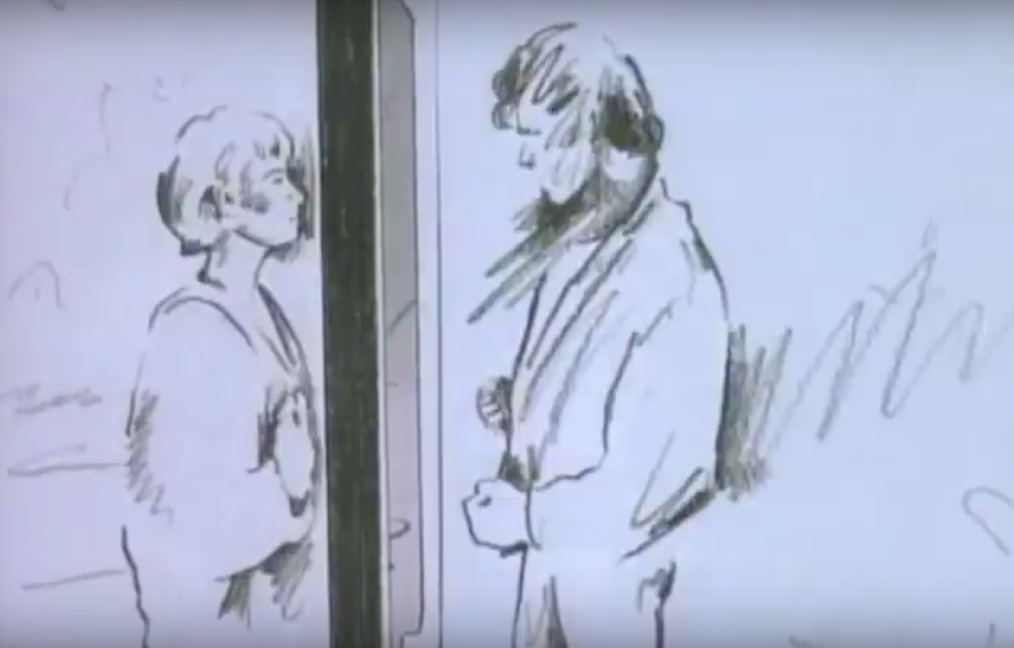
The video begins with lots of still, hand-drawn images cutting to each other in time with the drum beat.

We immediately see the face of the man, with the camera zooming in on his picture which connotes that he's our protagonist.


Although they are static frames, they are structured a lot like a camera would be, using a selection of close-ups to begin building the story, just like in the music video 'Wishing Girl'. I really like this way of introducing information as it makes the video more interesting to watch as we're not just spoon-fed the story from the start.


Interestingly, they use a lot of zooms, both in and out, at the start of the video. I'm not sure if I like this effect, I don't really like zooms on camera as I feel they can sometimes make it look amateurish and clumsy.


They have played the images together to create a stop-motion animation of a motorbike race however, they do not run quickly, instead each image stays on screen for marginally too long for it to be a smooth animation.


However, I like this effect as it makes it feel more authentic and connotes that it's part of a comic book, not a TV animation.

When the lyrics start we cut to a high angle shot looking down on the comic book, denoting that the images we'd seen were from the same story.


Then we see a low angle shot looking up at a girl and her turning a page, denoting that she's the one reading the book.


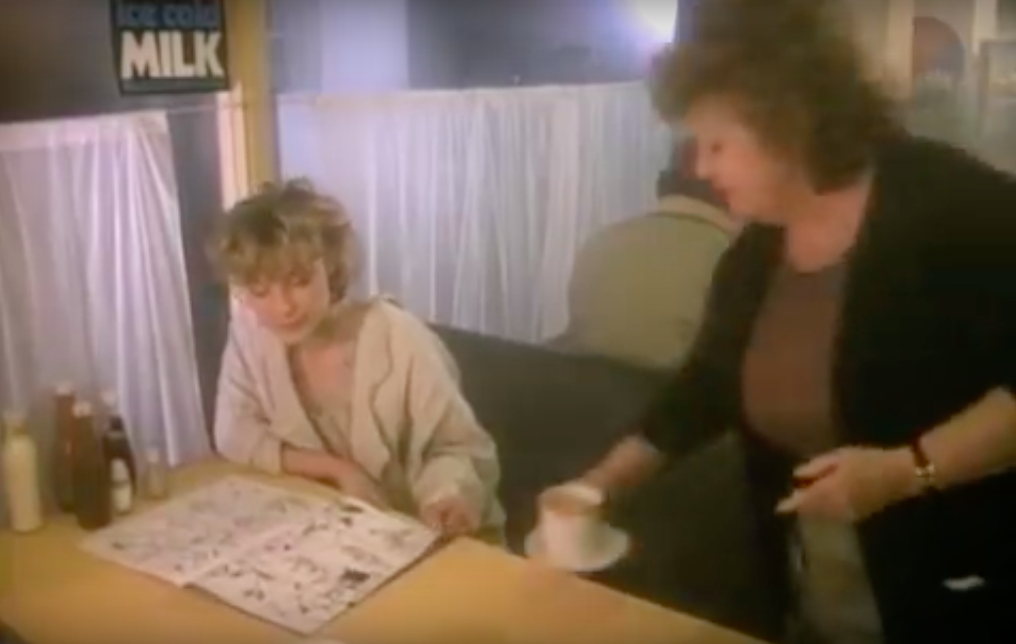
We then get a two-shot of the girl and a waitress delivering coffee, denoting that she's in a café.


The girl is dressed all in white which contrasts to the dark clothes of the waitress, connoting that she's the good character and the one who we should connect with as white has connotations of innocence and purity. It also links her to the black and white comic book she's reading as the overriding white colour of the book matches her white outfit. This foreshadows the later events in the story, her entering the comic.

It then cuts to a master shot of the café, further denoting the location of the girl, however, our view of her is obscured by the net curtains across the window, separating her from the rest of the people in the café.

This connotes her role as the protagonist and the white of the curtain also connects with her clothes and the white of the comic book.

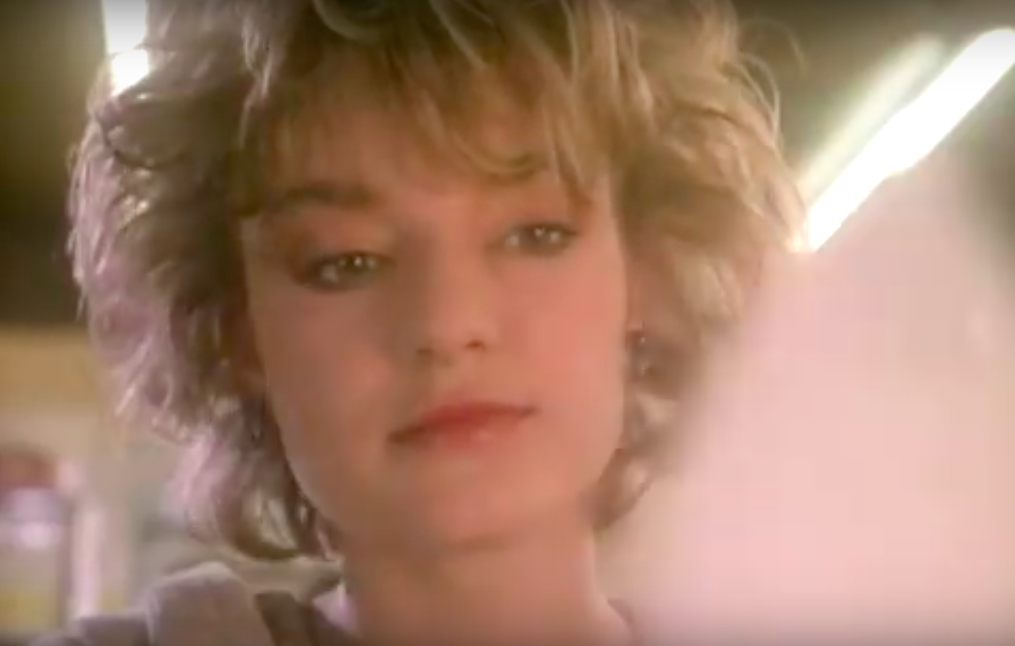
The close-up of her face connects us to her by allowing us to read her emotions more clearly and the fact that we can't see anything other than her connotes her fascination with the book.


They then use structuralism to connote the connection between the man in the comic and the girl in the café by using a close-up of his face then cutting to an extreme close-up of her eyes and then back again.


This makes it very clear that the narrative is going to involve the relationship between these two characters.
Immediately after we get an extreme close-up of the man's eyes before he winks - something we know a comic shouldn't do.


The extreme close-up puts emphasis on the importance of this action, connoting that this idea is going to be the basis of the video.

Then we have a mid-shot of her at the table with an animated hand reaching out of the comic towards her.


The use of the mid-shot gives us more of a view of the setting, effectively contrasting real life with the world of the comic, connoting that the hand is not only inviting her to explore the comic, but also to escape her own reality.
This is further emphasised through the wide shot of the rest of the café which is composed of mostly dull, muted colours, except for a man in a red shirt in the mid-ground, just off the centre of the shot.


Red connotes love, foreshadowing the future relationship of the two characters and the shot of excitement this offers to her otherwise boring life, connoted by the shot of colour the shirt offers on the muted background.

After a final extreme close-up of him and her, reaffirming their potential relationship, there is a close-up of her taking his hand in the centre of the composition, connoting the significance of the moment.


There is a fade transition to a two-shot of them both in the comic, denoting that she's just entered the world of the book she was reading. The two shot connotes their budding relationship and foreshadows their future love, also linking to the lyrics of the song.


There is a wide shot of him leading her through the white comic, setting the scene to confirm that they have left the world of the café.


He leads her to a window where, when stood behind it, he becomes real.


The background of this is clearly shot in a studio against a backdrop designed to look like the comic world.
He then begins to lip-synch the song to the girl, leaning in and out of the frame so part of his body's cartoon and part of it's real, emphasising the effect.


This is intercut with shots of the band playing on the same background, giving an image to the audience of what they're listening to, all with close-ups to fit with the pacing of the song.


There's then an 8 second clip of them on either side of the mirror whilst the camera pans around on a 180 degree curve to show both of their real forms.


This is very effective and symbolic of how they're worlds keep them apart by physically putting a barrier between them, keeping them both in separate forms.

We then get a very interesting effect on the musicians where a part of their body is real and part is cartoon.


This is a clever way of experimenting with the effect to make the music video more interesting for viewers whilst still getting screen time for the band.

We continue to get interactions between the cartoon girl and boy with cutaways to the band for a further 10 seconds before the story cuts back to real life and we see the waitress in the café looking at the empty seat the girl was in. This shows us the real world and serves as a somber reminder about the finite nature of the fantasy - the comic story must reach an end.


This shot is composed so the waitress, who is the main focus of the shot, is actually in the background connoting how no-one had previously noticed the girl's absence. However, she is also completely central, linking to how she's the main focus of the shot but also to how the girl's disappearance has now been noticed by the real world, connoting that the fantasy is coming to an end.


They have done a mid-shot on the waitress when she screws up the comic book, connoting the significance of this action, further foreshadowing the end of the cartoon relationship and causing a significant change of tone in the video.

There's then a tracking shot of her walking through the café to the bin with the screwed up book which is intercut with clips of the musicians.


The use of the band helps build tension as the music builds as we can see the more intense playing, making the viewer more aware of the change in the music. The waitress does an over-exaggerated throw of the comic into the bin to connote the turning point in the love story when everything must end.


This is further connoted by the close-up shot of the bin.


Immediately after this, inside the cartoon world, the couple get attacked by men and are forced to run.  The attacker runs into the foreground of the shot, stopping in the centre, connoting that he's the immediate source of danger that the viewer should be concerned with.


He then smashes the window between the two characters, shattering the illusion that they could ever exist in each others worlds.


This is shown in a mid-shot, slightly closer in than before to connote the significance of the symbolism.

The couple then run down a long corridor cutting between camera angles to increase the pace and build tension.We feel as though we're between the couple and the chasers as we see the couple from behind but the men from the front.


This puts us right in the middle of the action, effectively engaging the viewer in the video.


This effect is increased by a low camera angle used as they turn a corner, elevating the couple in the viewers eyes, connoting their status as the 'heroes' whilst also making the viewer feel small and therefore vulnerable in the situation, emotionally engaging them in the situation.

When the couple reach a dead end, the camera zooms in towards the chasers, ending in a two shot which contrasts with the following shot which is simply a close-up of the women.


This makes them appear outnumbered or, at least, lacking in power and connotes an imminent danger.
They continue to be shown in separate shots, connoting their vulnerability, until a few seconds later where they're shown in a two shot.


However, the camera is quite far away, making them appear small and they're in the centre of the shot, causing them to appear overwhelmed by the wide background which surrounds them. All this builds sympathy in the viewers towards the characters.

When she climbs out of the painting, we get another low angle shot, further connoting their status as the protagonists and their potential as a couple, hinting that it might not be the end of their relationship.


We then get a close-up of the man with the wrench in the foreground and in the centre of the shot, connoting that the attackers hurt, and possibly kill him.


This cuts instantly to a ceiling fan, a very mundane object which denotes that we're back in the real world.

We then get a point of view shot from the woman with all the café customers and waitress looking at her, connoting something's wrong.


This cuts to a high angle shot of her on the floor, connoting she's come out of the bin where the waitress threw the comic book.


Her white dress is stained which denotes she's been physically hurt by what happened in the comic however, it also connotes that she's been emotionally hurt by having to leave the man in what she knows was a dangerous situation.
There's a close-up of the waitress, then one of the girl, connoting their equal surprise in the situation. It cuts to a close-up of the girl reaching to get the comic out of the bin, again, using this camera angle to connote the significance of this action.


There's then a low angle shot of her running out of the café which mimics the angle used when her and the man were running through the comic.


This could connote that their relationship isn't over or, at least, that she's been deeply effected by what happened and these events will influence her real life.

There's a panning shot as she runs into her room, keeping up the tension built by her swift exit from the café by not stunting the flow of the video.

We then see a series of still images that denote the rest of the comic story which are intercut with close-ups of the girl's face, allowing us to see her emotion and therefore connect and sympathise with her.

In one shot, the girl looks up as the camera zooms in on her face, connoting that something of significance is building.


On the next close-up of the comic book a special effect starts on the cartoon man and he appears in the hallway.


The next montage of shots are all very short and cut between him and her, creating a hectic feel denoted by the man's behaviour - flinging himself against the walls as he changes out of cartoon form.


The hectic tone is also created by the fast paced cuts between a high range of shot types used - close-ups (mostly of the girl), mid-shots and long-shots.

When he breaks free from his cartoon form the shots stay for longer on each of the character's faces, connoting that they've made it through the challenges of the story and are free to be together.


The video ends with her walking out of the frame towards him in a very romantic manner.


It then cuts to an image of them on a magazine cover overlaid with a cartoon version of them kissing, creating a little ambiguity over whether he's joined her world or she's joined his.


Overall this video is really good, I love the effects put on the comic book parts which make it look jumpy and authentic. It's very distinctive and memorable, with the cartoon element as its defining feature making it stand out amongst the sea of other 80s videos.